

Know thyself. Anything worth doing is worth doing badly. One of those phrases is inscribed on the Temple of Apollo at Delphi. The other was probably inspired by a crappy blog post circa 2012. Both are relevant to today’s essay.
I’m writing this to reflect on what I’m learning from my seemingly failed attempts at talking about challenging issues with my students. I hate doing things badly, and I suspect I’m not alone in that.
A big part of The Next Right Thing is about communication skills informed by cognitive science findings on identity and cognitive dissonance. But my aim is not to pretend I’m an expert or that I always get things right. Indeed, I often realise that I’ve handled a conversation poorly.
I’m going to describe a recent moment when sharing accurate but distressing information about an environmental issue backfired, and how a simple technique that emphasises action possibilities can help people remain curious by protecting their sense of agency.
Last week I saw a short video about a recent scandal involving PFAS, so-called forever chemicals, in France. The video highlighted how thousands of hectares of farmland in France have been contaminated with these harmful and long-lasting substances. Farmers have been left without a livelihood and discovered that their own bodies had been poisoned by the land they were tilling.
What is particularly disturbing about this is how it happened. It didn’t involve a chemical spill and it wasn’t an accident. For years farmers were given fertiliser provided by local industries such as paper mills, chemical plants and food processors. It was sold as affordable, high-quality compost. But it was in fact derived from industrial waste that contained high amounts of PFAS. What seemed like a win/win solution for industry and farming was in fact a way for industry to get rid of toxic waste by passing it off as harmless fertiliser in a process promoted as “agricultural recycling” (revalorisation agronomique).
Shortly after seeing this eye-opening video I had my first class of the day, a group of second-year law students. With a surge of adrenaline, I told them about it. I assumed they would be as fascinated as I was. After all, last semester we studied environmental law and they had expressed some interest in the topic. Yet to my surprise, my students seemed indifferent. A few students glanced at their laptops. No one said anything. And as I probed them to see why they weren’t more concerned about the issue of PFAS, one student finally piped up and said, “You know, I love football. But if I always talk about Barça people will get bored.” He went on to suggest that their patience with me was wearing thin because I talk so much about the environment.
Let’s return to that wise injunction “know thyself”. What do we do when we realise that our love for an issue may not actually make us effective advocates for it? Here are my thoughts. First, I was lucky because that student I mentioned came to speak to me after class. We stood in the hall, where we spent the next twenty minutes sharing our views.
He started out by telling me that it wasn’t that he didn’t care about the environment, he did. He told me about deep his love for sharks and his distress at the recent rollbacks of laws designed to protect their welfare. In other words, his indifference in class wasn’t indifference at all. What he didn’t like was the sense that the world was just a terrible place and that it was getting worse and there was nothing we could do about it. And me telling them about this news story landed as yet one more confirmation that the world is basically a bad place.
I am grateful to my student for that conversation. It reminded me not to jump to the conclusion that others don’t care about something just because they don’t express immediate enthusiasm. It also made me think of the idea of generative conflict, a term used by Adrienne Maree Brown in Emergent Strategy. That is, some conflicts are worth having even when they are uncomfortable in the moment because they bring about something valuable.
The Next Right Thing GPT is trained on a handful of key thinkers, one of whom is Sarah Stein Lubrano. A key insight from her book Don’t Talk About Politics is that we are unlikely to change our beliefs or our behaviours if we don’t feel like we have agency. In other words, if we don’t feel that as individuals we can actually make a difference then all of the information in the world will be for nought.
As I was reviewing how I presented that news story to my students a few things became clear. By asking my students what they thought they could do about the issue of PFAS, I was at a very high level of abstraction. Questions like “What can we do about this?” sound empowering, but they can actually be paralysing. The problem is enormous, the responsibility vague and as individuals we feel very small in comparison. It’s kind of like starting a debate about freedom of the will while staring at a pile of dirty laundry. It might be a fascinating question but you might regret it tomorrow when you’re rummaging through a pile of dirty socks. We aren’t looking for absolute truths but rather action possibilities. People rarely move from concern to action through information alone. They move when they can see a path forward, even a very small one.
It’s at this point that I remembered a very simple technique from Motivational Interviewing (MI). This is a widely-accepted approach that was originally used for helping people with substance abuse problems and is now used in different contexts where someone feels ambivalent about an issue.
When working with someone considering sobriety you offer them a menu of options of experiences they could explore. They might include the following:
- Listen to a podcast episode about sobriety.
- Keep a record for one week of when and why you feel like drinking.
- Order a non-alcoholic drink the next time you go out socially.
- Research the recommended daily alcohol limits in your country.
- Calculate how much you spend per month on alcohol.
Notice how none of the options actually includes giving up alcohol. They are all low-stakes, short experiments. Importantly, you always leave a space for some of the client’s own ideas; the menu should always allow for personalisation. Also, it’s often presented in the form of a bubble sheet, that is, each option appears in its own little circle. This might seem insignificant, but I think this engages our visual system in a useful way. Each option appears like a little portal, a clear way forward.
If I were to discuss this news story again, I wouldn’t ask “What do you think you can do about PFAS?” Instead, I would project on the board a menu of options asking which one the students would be willing to try in the next week.
- Read an article on one environmental issue (PFAS, plastics, soil loss, biodiversity, etc.) affecting your region.
- Ask someone you know what environmental issue they care most about.
- Follow one scientist or journalist working on environmental issues.
- Spend time in nature and reflect on what you value about it.
- Write down three questions you have about environmental problems.
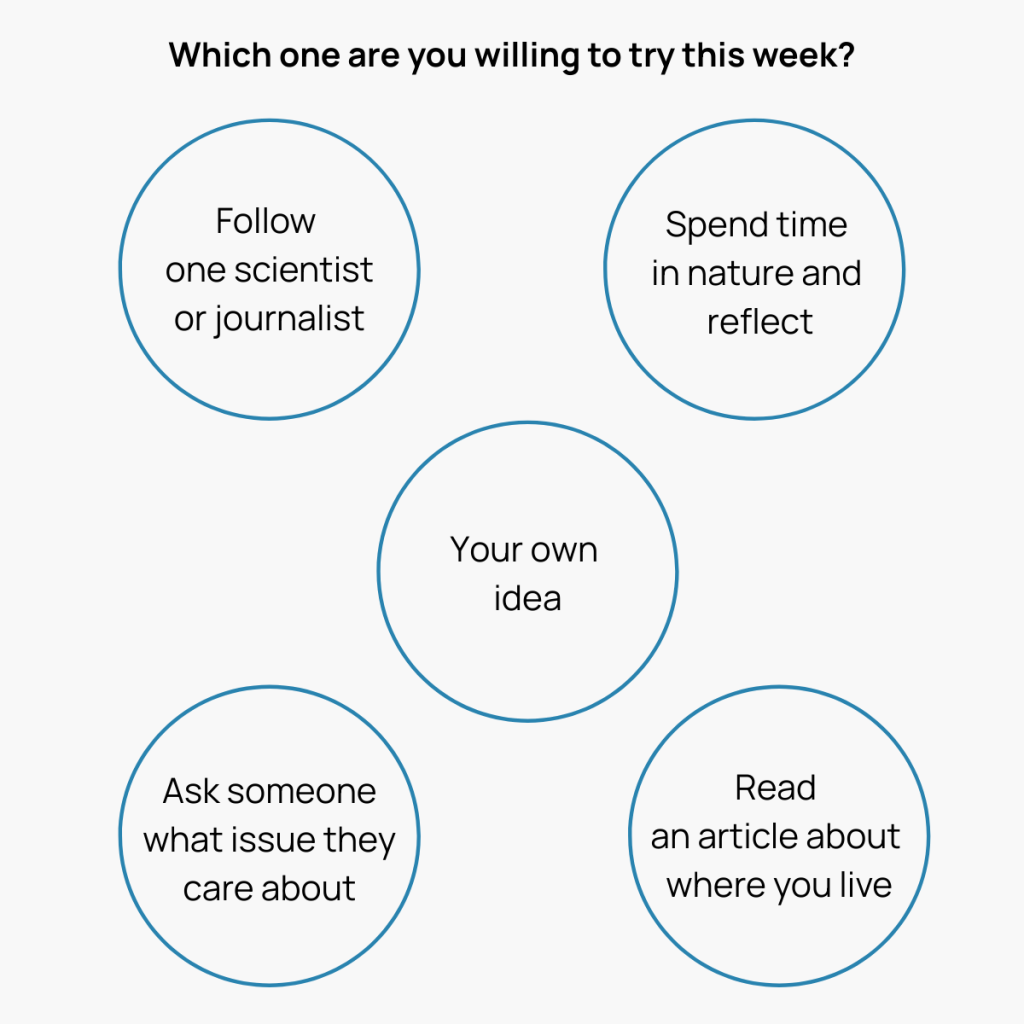
And of course, I would leave a bubble blank for their own ideas.
As I was researching this piece I came across two developments that illustrate what I mean by action possibilities. Euronews recently reported on France’s ban on PFAS in clothing and cosmetics. And Euractiv covered a lawsuit brought by 192 claimants near Lyon seeking €36 million in damages from two chemical companies in what may be Europe’s largest civil case over PFAS contamination.
These examples matter not because they “balance out” the bad news, but because they show that responses are already underway. Legislators are regulating. Citizens are organising. Lawyers are bringing cases. Courts are being asked to adjudicate responsibility. These are not abstract solutions but roles people can step into. When we talk about difficult problems it helps to highlight these kinds of affordances, that is, visible opportunities for action. Without them people are left with the impression that nothing can be done, and as Sarah Stein Lubrano argues, people who lack a sense of agency are unlikely to change their beliefs or their behaviour.
Knowing ourselves and knowing one another means a shift in the way we communicate. When we tell others about important problems we need to embed action possibilities, especially when our audience might be disengaged. One simple way of doing this is by suggesting a menu of options, presented as short-term experiments. And don’t worry about doing it perfectly. Try a few small experiments. Sometimes the next right thing only becomes visible once we start looking for the action possibilities around us.
Sources
Disclose NGO — FAS: the manufacturer of sugar brand Daddy fosters forever chemicals
Euronews — France’s ban on ‘forever chemicals’ comes into force today. Here’s what will change
Euractiv — FAS pollution: French citizens take on chemical giants
Continue the conversation
The Next Right Thing isn’t only a series of essays. It’s an experiment in thinking together.
If you’d like to explore these ideas further, you can try the TNRT GPT, which draws on many of the ideas developed in the text.
You can also find out about live events online here.
If you want to explore further, you might ask:
- I care about issue ______. What small action possibilities or experiments might help someone engage with it without feeling overwhelmed?
- What keeps us from noticing the action affordances already present in our environment?
- How might the way we frame a problem change the action possibilities people are able to see?